

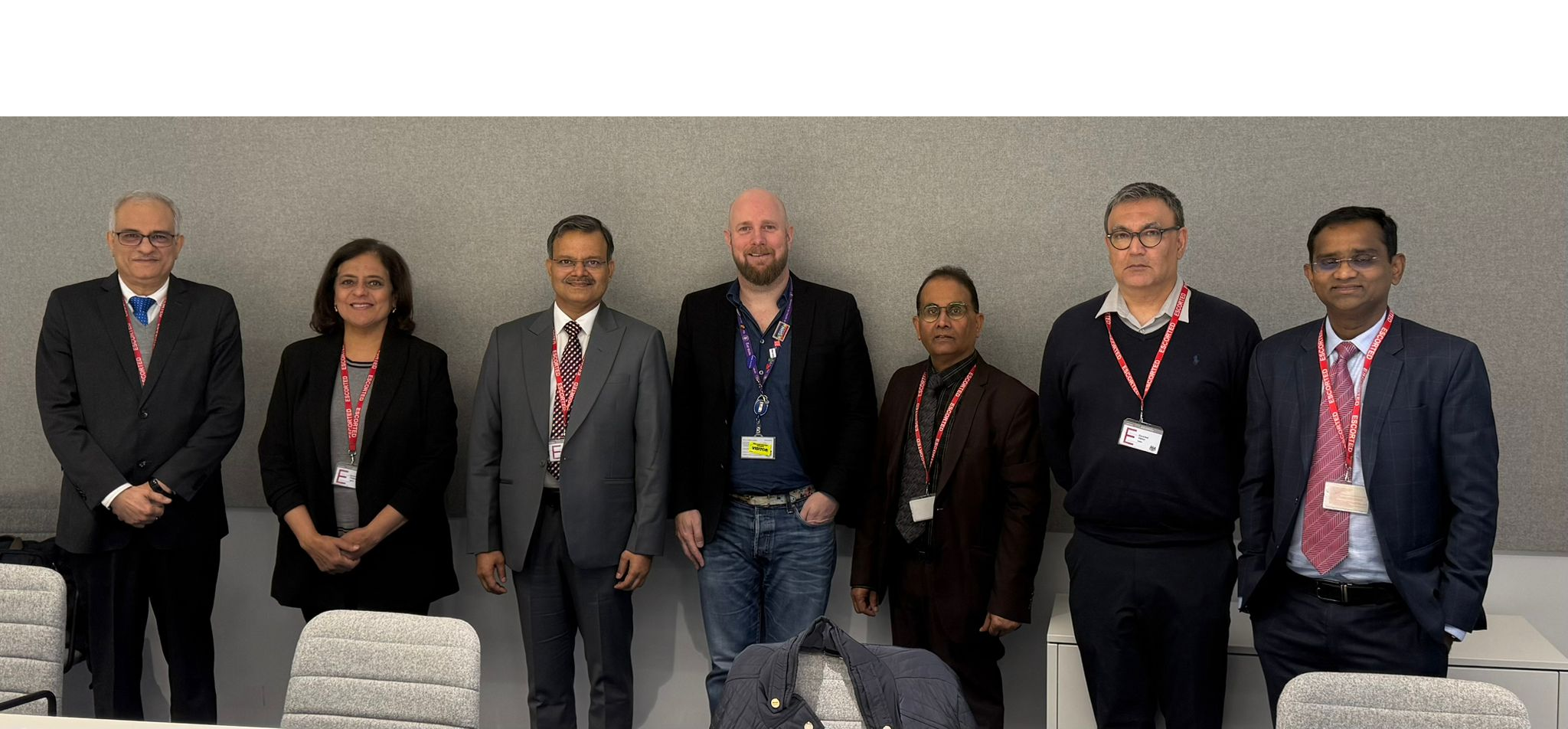
What can other countries learn from the NHS? And what can we learn from our international counterparts? The Health Economics Unit was proud to host the World Bank Group and India’s National Health Authority for an expert knowledge-sharing visit at the start of November.
Across three days the Health Economics Unit (HEU) brought together health and care experts from across England to share their insights and experience around using data to improve decision making.
As well as visiting the HEU’s offices in London, the delegation was also welcomed at Liverpool’s Civic Health Innovation Labs (CHIL) and Alder Hey innovation Centre. Below is a summary of some of the speakers and the insights shared across the three days.
Andi Orlowski, Director, Health Economics Unit
The state of digital in the NHS
Andi presented a high-level review of NHS digital evolution, lessons learned, and global context. He chronicled decades of transformation — from failed top-down programs (NPfIT, care.data) to localised innovation, and highlighted the Covid-19 pandemic as a catalyst for digital adoption and data infrastructure.
Key takeaways included the balance of major achievements, including widespread EPRs, NHS App uptake, and NHSX leadership, with persistent issues, including legacy systems, interoperability, uneven digital maturity, and underinvestment.
Andi placed an emphasis on “People before technology” and “Local delivery, national standards.” He noted how the UK’s experience offers global lessons in transparency, local adaptability, and civic trust, all of which are critical for digital success.
Matt Oakes, Head of Intelligence and Analytics, Sherwood Forest Hospitals NHS Foundation Trust
An exploration of how hospitals are scaling digital infrastructure
Matt discussed the NHS Federated Data Platform (FDP), a national shared infrastructure built on AWS and Palantir Foundry. The platform is designed for secure data sharing, common models, and analytical reproducibility across organisations. Matt explored how it helps tackle long-standing issues: fragmented systems, data silos, poor quality, and lack of interoperability. Current successes include millions of patient records validated and large reductions in waiting lists.
Matt’s key insights included emphasising the importance of foundations – the data platform is a rate-limiting factor in your ability to use data effectively, and variation in platforms has hindered NHS organisations significantly over the past.
Technologies such as the Federated Data Platform (FDP) are capable of being a good foundation, and enabling the NHS to address its biggest problems through data.
Engaging the analytical community in creating and deploying a common data platform across a health service is critical to its success.
Henry Ireland, Programme Director, South West Secure Data Environment
A regional integrated data view of scaling digital public infrastructure
Henry presented around his work and insights from the South West Secure Data Environment, a rapidly emerging dynamic research database, that seeks to link deep level data across multiple points of care. The database covers 5 million+ patients across six ICBs and SWASFT.
Henry’s presentation discussed how the programme has approached building trust, infrastructure and buy-in at a regional footprint, whilst navigating some of the unique challenges and opportunities that come with a rural and coastal health economy.
He emphasised making sure different organisations (GPs, hospitals, councils, tech companies) can easily and safely connect to each other using shared standards. And advocated supporting consistent, secure, and efficient delivery of digital health services across regions, while building trust in how data is handled, stored, and shared.
David Sgorbati, Chief Analyst, Health Economics Unit
Using data to improve outcomes and upskilling the workforce (two sessions)
In the Putting Data to Use session, David explored how health and care systems can move from collecting data as a by-product of service delivery to using it as a strategic asset for improvement. He emphasised that analyses should always begin with a clear purpose, guided by the decisions they are intended to inform, and that the greatest value comes from linking datasets across care settings to understand the full patient journey.
David highlighted the importance of combining quantitative insight with local and contextual understanding, co-designing tools with those who will use them, and ensuring that transparency, reproducibility, and feedback loops build trust in evidence. The session demonstrated how connecting, interpreting, and sharing data meaningfully can turn information into action and lead to measurable improvements in care and outcomes.
In the Creating Analytical Capabilities session, David focused on building the skills, culture, and confidence needed to make data-driven decision-making sustainable. He described how the Health Economic Unit’s work increasingly involves “learn-by-doing” approaches, where they guide teams through solving real problems while training them on each step. This ensures capability is built through practice rather than theory alone.
The HEU’s programmes blend online and in-person learning, hands-on exercises, and applied assignments, with an emphasis on foundational skills such as Population Health Management, coding and analytics, health economics, and allocative efficiency.
Both sessions reinforced the principle that true transformation happens when systems can generate and use their own insights. By developing local expertise, fostering peer learning, and embedding evidence-based thinking into everyday practice, we help create health and care systems that are self-sufficient, resilient, and continuously improving.
Tom Stocker, Digital Transformation Lead, The Clatterbridge Cancer Centre NHS Foundation Trust
The struggles and surprises of working with data in the NHS
Tom drew from his time in the NHS to share ten years of stories of changing health services using data and what India can learn from those experiences. He emphasised truth-seeking and persistence (“Satyagraha”) in confronting bias, inefficiency, and vested interests through evidence.
Tom’s presentation included real-world examples of these practices, including addressing racial bias in GMC outcomes, redesigning MSK services to save £2m/year, data-led pathway redesign yielding £6m annual savings and nationally scaling an early cancer diagnostic service.
Tom said that his key takeaway was that data can take you to very interesting places and conclusions that you didn’t expect it when working with health systems and commissioning care provision. And actually, that’s where some of the biggest benefits and best projects are hiding.
Kavitha Saravanakumar, Interim Chief Information Officer and Director of Business Intelligence, NHS North West London
Whole systems integrated care
Kavitha introduced Whole Systems Integrated Care (WSIC), a linked, longitudinal dataset covering 2.9 million population in North West London. She explained how WSIC is set up under the vision of developing a ‘single source of truth’ of an integrated care record that can be used for multiple purposes i.e. direct care, population health management as well as public health analysis and research.
WSIC Supports Population Health Management (PHM) and reduction of health inequalities. It uses Core20Plus5 and Focus-On frameworks to prioritise deprived communities and key disease areas (e.g. CVD, AF, cholesterol).
In her talk Kavitha recommended making the core digital systems (like patient identity, data exchange, and secure access) available to all parts of the health and care system. She explained the importance of ensuring those systems can handle more users, more data, and more services without breaking.
Daniel Offord, Head of Digital Transformation, and Paul Atkinson, Digital Director, Gloucestershire Integrated Care Board
Daniel and Paul gave an overview of One Gloucestershire Integrated Care Board (ICB), which covers a population of 660k, and its Enterprise Architecture for health and care.
The presentation focused on their business-led enterprise architecture approach in the Gloucester system, and alignment with the more technical approach taken by Bristol, North Somerset and South Gloucester ICB. They covered the opportunities and challenges of integrated care in Gloucestershire as well as citizens experiences and business workflows.
Their talk flagged key capabilities – including the shared care record (JUYI, or “Joining Up Your Information”), the linked dataset and the utilisation of Joh Hopkins ACG cohort tool. They emphasised “digital capabilities” over “digital solutions”, focusing on architecture, interoperability, and shared governance.
Shaun Rowark, Associate Director Healthcare Data Analytics, NICE
Real-World Data in Health Technology Assessment
Shaun Rowark drew on more than a decade of experience working in the health informatics space for his talk. As Associate Director of NICE, Shaun explained how he focuses on the use of health data to drive innovative approaches to health technology appraisal and national guidance. He covered NICE’s transformation to make guidance faster, fairer, and more data-driven.
Shaun gave his perspective on the changing UK healthcare data landscape and its development in recent years. He explained how NICE thinks Real-World Data can be used in Health Technology Assessment, and gave an introduction to the RWE framework.
NICE’s approach aligns with NHS priorities for smarter spending, parallel regulatory approvals, and rapid innovation adoption. Shaun explained that their future focus has become federated data, AI/ML in causal inference, and synthetic data generation.
Civic Health Innovation Labs (CHIL)
Tackling Global Health Challenges with Civic Data and Innovation
An introduction to Civic Health Innovation Labs (CHIL) and the Civic Data Cooperative model; using data as shared civic infrastructure for health and social impact.
Included an overview of Digital Governance Frameworks, ensuring security, accountability, and trust in shared health data.
Discussion included the transformation of Learning Health Systems to Civic Learning Systems, an evolution from internal NHS data audits to integrated, citizen-inclusive systems leveraging AI for preventive and equitable health.
A data-driven focus on multi-morbidity, deprivation, and social care interdependencies helps to tackle health and care inequalities. And speakers looked at Covid-19 as a data mobilisation case study: the Liverpool Covid-SMART pilot and CIPHA system demonstrated large-scale, data-enabled public health interventions.
Attendees were also introduced to the Data Into Action (DIA) Programme, NHS Cheshire & Merseyside’s practical data integration framework for targeting complex households, using linked datasets to improve prevention and population health.
Key insights included the fact that health systems must be optimised as wholes, not siloed components. Trust frameworks and civic participation are essential to sustain data sharing.
Other takeaways included that AI-driven “avatars” and predictive models can support personalised and preventive care. And public engagement (citizens’ juries, charters on data and AI) helps bridge the “data-action gap.”